Qatar Environmental Permit Noise Requirements – A Complete Compliance Guide
As Qatar continues to expand its industrial and infrastructure projects, environmental regulations play a critical role in protecting community health and sustainability. One of the key elements of environmental compliance is adhering to the Qatar Environmental Permit Noise Requirements established by the Ministry of Environment and Climate Change (MoECC).
For any organization undertaking construction, manufacturing, or operational activities, understanding these noise requirements is essential for obtaining and maintaining an environmental permit in Qatar.
Understanding Environmental Noise Regulations in Qatar
Qatar Environmental Permit Noise Requirements are designed to control and limit noise pollution from various industrial, commercial, and construction sources. These standards aim to ensure that noise emissions do not negatively affect nearby communities, workers, or the natural environment.
The MoECC evaluates noise levels during the Environmental Impact Assessment (EIA) process. Applicants must demonstrate that their projects will meet the specified environmental noise criteria before receiving approval.
Typical aspects covered under noise permit conditions include:
Maximum permissible noise limits for daytime and nighttime operations.
Noise level monitoring plans to verify ongoing compliance.
Mitigation measures such as acoustic barriers, silencers, or operational controls.
Reporting and documentation for environmental audits and inspections.
Who Needs to Comply with Qatar’s Noise Requirements?
Any organization or project that generates significant noise is required to comply with the environmental permit noise standards. This includes:
Construction and infrastructure projects (roads, rail, and buildings).
Oil & gas and petrochemical facilities.
Power generation and desalination plants.
Manufacturing and processing industries.
Airports, ports, and transportation hubs.
Failure to meet Qatar’s environmental noise permit conditions can result in fines, project delays, or suspension of operations.
How JAB International Consultancy Supports Compliance
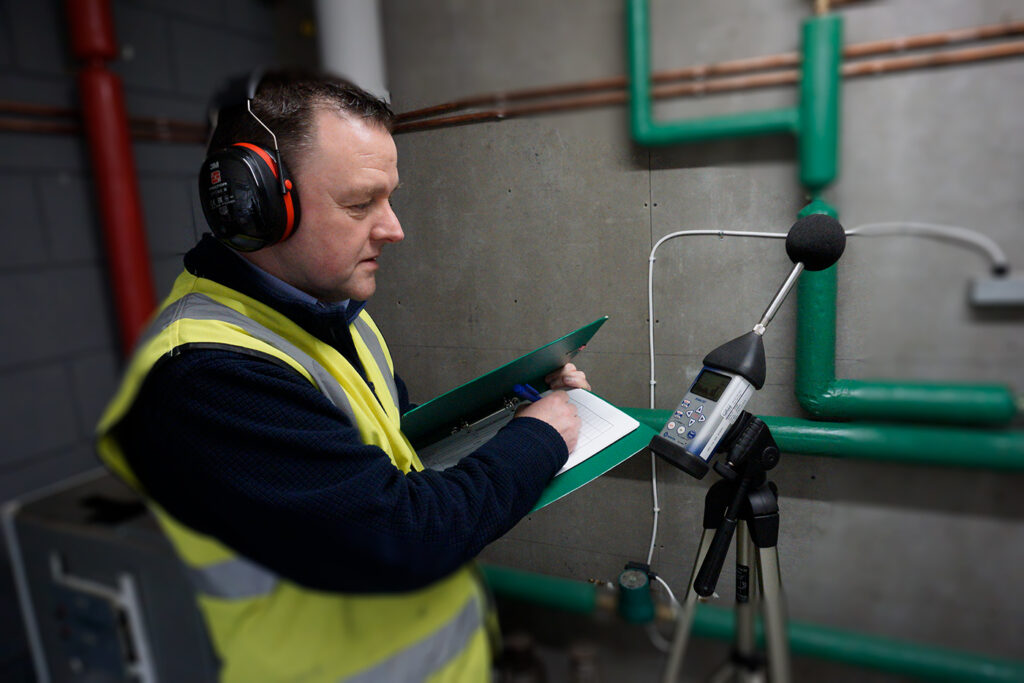
At JAB International Consultancy, we help organizations navigate and comply with Qatar Environmental Permit Noise Requirements through specialized monitoring, assessment, and reporting services.
Our expertise includes:
Baseline noise surveys prior to EIA submissions.
Environmental noise monitoring during project operations.
Noise modeling and prediction studies for permit applications.
Mitigation strategy design for regulatory compliance.
Technical reporting aligned with MoECC and ISO 1996 standards.
We ensure that all environmental documentation and evidence meet the necessary standards for successful permit approvals and renewals.
For reference, you can also review the World Bank Environmental, Health, and Safety (EHS) Guidelines for Noise Management, which serve as an international benchmark often considered during environmental assessments.
Benefits of Meeting Qatar’s Environmental Noise Standards
Ensures compliance with MoECC permit requirements
Supports faster project approvals and renewals
Reduces community noise complaints
Demonstrates environmental and corporate responsibility
Promotes sustainable and safe working environments
Conclusion
Meeting Qatar Environmental Permit Noise Requirements is not only a legal obligation but also a commitment to sustainable development and community well-being.
At JAB International Consultancy, our team of experienced HSE professionals provides end-to-end support — from baseline surveys and modeling to compliance reporting — ensuring that your projects meet Qatar’s environmental noise regulations efficiently and accurately.
By partnering with us, you can operate confidently within Qatar’s regulatory framework while maintaining your environmental and operational integrity.